
Modafinil vs Adderall: Differences, Uses & Abuse Risk

Modafinil vs Adderall both promote wakefulness and cognitive focus.
Modafinil and Adderall differ fundamentally in pharmacological mechanism, legal classification, abuse potential, and approved clinical indications.
Adderall is a Schedule II amphetamine that floods the synapse with dopamine and norepinephrine through transporter reversal; modafinil is a Schedule IV wakefulness-promoting agent that inhibits dopamine reuptake through a comparatively controlled mechanism.
Understanding how these two drugs work differently, where their effects overlap, and why both carry real misuse risks is essential for safe clinical decision-making.
Key Takeaways
- Modafinil is FDA-approved for narcolepsy, shift work sleep disorder, and obstructive sleep apnea-related sleepiness; Adderall is FDA-approved for ADHD and narcolepsy. Neither drug is approved for cognitive enhancement in neurologically healthy individuals.
- According to the National Institute on Drug Abuse, approximately 4.8 million people in the United States misused prescription stimulants in 2022, with college students and working professionals representing the highest-prevalence misuse populations.
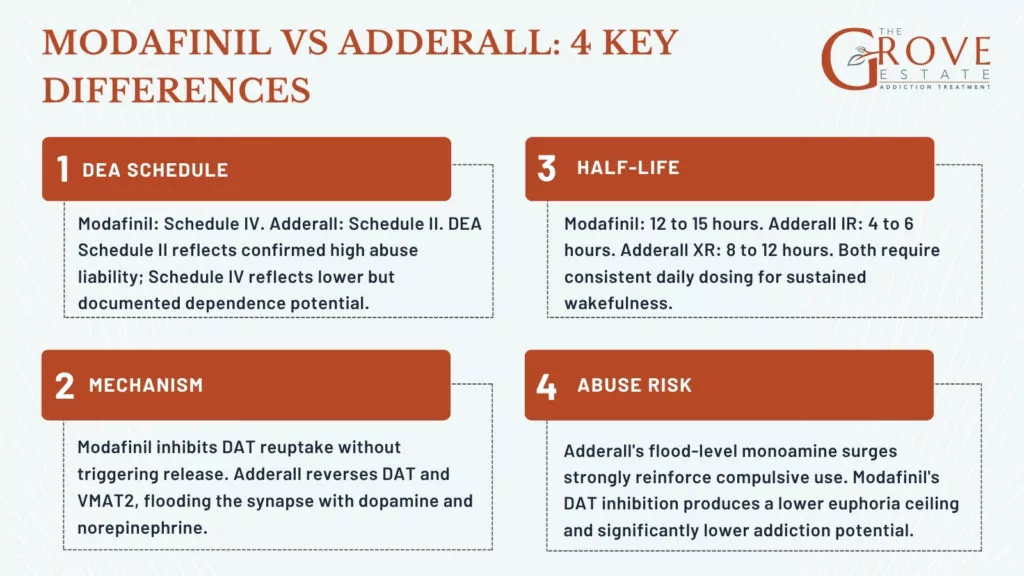
- Adderall drives dopamine and norepinephrine release by reversing the direction of the dopamine transporter (DAT) and vesicular monoamine transporter 2 (VMAT2), flooding the synapse; modafinil inhibits DAT to slow dopamine reuptake without triggering active release, producing a comparatively modulated neurochemical response.
- The DEA classifies Adderall as Schedule II, the highest abuse liability category for a legally prescribed drug; modafinil carries Schedule IV classification, reflecting lower but clinically documented potential for dependence.
- Both modafinil and Adderall reduce the efficacy of combined oral contraceptives through CYP3A4 enzyme induction, an interaction absent from most consumer drug information resources that affects women relying on hormonal contraception.
Did you know most health insurance plans cover substance use disorder treatment? Check your coverage online now.
Modafinil vs Adderall: Side-by-Side Comparison
Modafinil and Adderall share some clinical effects but differ substantially in mechanism, risk profile, and regulatory classification in ways that are clinically relevant to prescribing decisions and misuse risk assessment.
| Parameter | Modafinil (Provigil) | Adderall (mixed amphetamine salts) |
|---|---|---|
| Drug class | Eugeroic / wakefulness-promoting agent | Amphetamine / CNS stimulant |
| DEA schedule | Schedule IV | Schedule II |
| FDA-approved uses | Narcolepsy, shift work sleep disorder, OSA | ADHD, narcolepsy |
| Primary mechanism | DAT inhibition; orexin/histamine activation | DAT and VMAT2 reversal; monoamine flood |
| Half-life | 12 to 15 hours | IR: 10–13 hours; XR: 10–13 hours |
| Onset of effect | 1 to 2 hours | 30 to 60 minutes (IR) |
| Abuse potential | Lower; documented but Schedule IV | High; Schedule II |
| Appetite suppression | Mild | Significant |
| Cardiovascular risk | Mild (blood pressure, heart rate) | Significant (hypertension, arrhythmia) |
| Contraceptive interaction | Yes (CYP3A4 induction) | Yes (CYP3A4 induction) |
| Approved for ADHD | No (off-label use only) | Yes |
| Misuse deterrence | Lower euphoria; less reinforcing | Significant euphoria at high doses |
What Are Modafinil and Adderall?
Modafinil and Adderall are both central nervous system stimulants used to promote wakefulness, but they come from distinct pharmacological classes with different risk profiles and approved indications.
Modafinil (Provigil) is a wakefulness-promoting eugeroic classified as Schedule IV by the DEA. The FDA approved it for narcolepsy, shift work sleep disorder, and residual sleepiness from obstructive sleep apnea. Its half-life runs 12 to 15 hours; armodafinil (Nuvigil), the R-enantiomer, extends that to 15 hours. Modafinil carries no FDA approval for ADHD, though off-label use is documented. Schedule IV classification reflects lower abuse potential than amphetamines but does not eliminate dependence risk.
Adderall is a mixed amphetamine salt containing 75% dextroamphetamine and 25% levoamphetamine, available in IR (4 to 6 hours) and XR (8 to 12 hours) formulations. The DEA classifies it as Schedule II, reflecting high abuse liability and confirmed dependence risk. FDA-approved indications are ADHD in patients aged 3 and older, and narcolepsy in adults. Per NSDUH tracking since 2002, Adderall diversion for cognitive enhancement has risen consistently, particularly among college students.
How Modafinil and Adderall Work Differently in the Brain
The pharmacological distinction between modafinil and Adderall determines their clinical potency, side effect profiles, abuse liability, and why modafinil “feels like Adderall” to users despite a fundamentally different mechanism.
Contact us today to schedule an initial assessment or to learn more about our services. Whether you are seeking intensive outpatient care or simply need guidance on your mental health journey, we are here to help.
Adderall’s Mechanism: Transporter Reversal and Monoamine Flooding
Adderall reverses the dopamine transporter (DAT) and vesicular monoamine transporter 2 (VMAT2), ejecting stored dopamine from the presynaptic neuron into the synapse. This produces a non-physiological dopamine and norepinephrine surge that saturates the nucleus accumbens and prefrontal cortex. That same surge drives therapeutic focus in ADHD and the reinforcing properties that make amphetamines Schedule II substances.
Long-term misuse depletes presynaptic dopamine stores, downregulates DAT expression, and reduces D2 receptor density in the striatum. The result is anhedonia, motivational deficits, and compulsive re-use during abstinence.
Mixing Adderall and alcohol accelerates this damage. Alcohol suppresses dopaminergic signaling while Adderall simultaneously overdraws dopamine reserves, deepening the neuroadaptive changes that sustain stimulant use disorder.
Modafinil’s Mechanism: DAT Inhibition and Histamine Activation
Modafinil inhibits the dopamine transporter by binding to DAT without reversing its transport direction. This inhibition slows dopamine reuptake rather than triggering active release, producing a more gradual and modulated increase in synaptic dopamine compared to amphetamine-driven flooding. Modafinil’s peak synaptic dopamine increase is substantially lower than amphetamine’s, which accounts for its comparatively lower but real addictive potential.
Modafinil simultaneously activates the tuberomammillary nucleus (TMN), the brain’s primary histamine-producing region, through mechanisms that are not fully characterized but appear to involve orexin/hypocretin neuropeptide pathway engagement. Histamine release from the TMN drives the wakefulness and alertness modafinil produces through a pathway distinct from amphetamine’s catecholamine surge.
This orexin-histamine mechanism explains why modafinil provides effective wakefulness in narcolepsy, a condition caused by orexin neuron degeneration, while producing less of the euphoric reinforcement that drives stimulant addiction.
Side Effects and Abuse Risk
Both modafinil and Adderall produce adverse effects through their CNS stimulant activity, though the severity profile differs substantially between the two drugs at therapeutic and misuse doses.
Are you covered for treatment?
The Grove Estate is an approved provider for Blue Cross Blue Shield and Cigna, while also accepting many other major insurance carriers.
Check Coverage Now!Common Side Effects of Each Drug
Common side effects of modafinil at therapeutic doses include:
- Headache: The most frequently reported adverse effect of modafinil, occurring in 34% of patients in pivotal trials; typically dose-dependent and manageable with dose reduction
- Nausea and gastrointestinal discomfort: Reported by approximately 11% of users; most pronounced when modafinil is taken on an empty stomach
- Insomnia: Modafinil taken late in the day extends wakefulness into the normal sleep window, disrupting sleep architecture and producing sleep deprivation with continued use
- Elevated blood pressure and heart rate: Modest catecholaminergic activity produces cardiovascular stimulation that requires monitoring in patients with hypertension
Common side effects of Adderall at therapeutic doses include:
- Appetite suppression: Adderall reduces appetite significantly through hypothalamic norepinephrine and dopamine activity; chronic appetite suppression causes nutritional deficiency and weight loss in long-term users
- Cardiovascular stimulation: Adderall elevates resting heart rate and blood pressure through norepinephrine transporter inhibition and direct adrenergic receptor activation, contraindicating use in patients with pre-existing cardiac conditions
- Insomnia and sleep disruption: Adderall XR taken after noon frequently produces middle insomnia from sustained catecholamine elevation that outlasts the therapeutic window
- Mood instability: Adderall crash following dose wearing-off produces irritability, fatigue, and dysphoria through rapid synaptic monoamine depletion as the amphetamine dose clears
Severe Effects and Signs of Stimulant Misuse
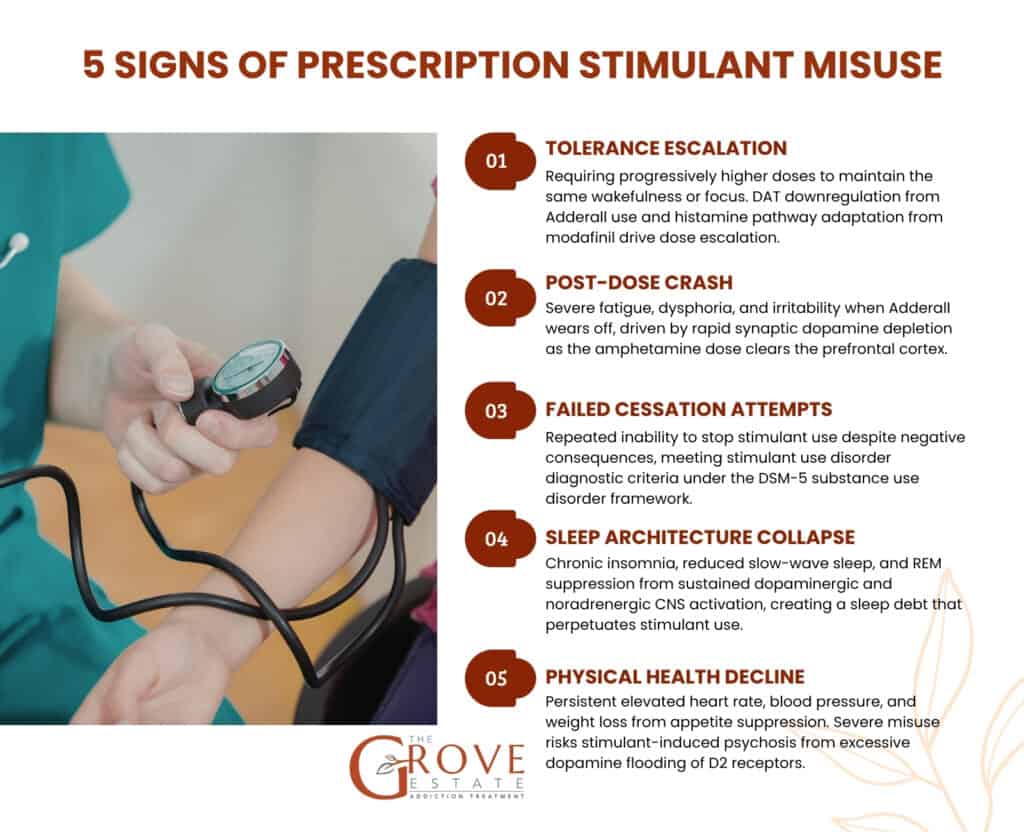
Stimulant misuse, defined as use outside prescribed dose, frequency, or indication, escalates adverse outcomes for both modafinil and Adderall and drives stimulant use disorder through the same neuroadaptive process that underlies other substance use disorders.
Seek emergency care immediately if any of the following develop:
- Chest pain or palpitations during or after stimulant use
- Systolic blood pressure above 180 mmHg (hypertensive urgency)
- Hyperthermia (body temperature above 104°F/40°C) with agitation and muscle rigidity
- Psychosis: paranoia, auditory or visual hallucinations, or disorganized thinking
- Seizures in a person with no prior seizure history following stimulant use
Adderall misuse at high doses produces stimulant-induced psychosis through excessive dopamine flooding of mesolimbic D2 receptors, clinically indistinguishable from acute schizophrenic episodes. This psychosis resolves with abstinence in most cases but requires clinical differentiation from a primary psychotic disorder at presentation.
Long-Term Risks and Stimulant Use Disorder
Long-term Adderall misuse depletes presynaptic dopamine stores, downregulates DAT expression in the striatum, and reduces dopamine D2 receptor availability, producing the hallmark signs of stimulant use disorder: compulsive use despite harm, inability to experience pleasure without the drug (anhedonia), and severe fatigue and depression during abstinence. These neurobiological changes partially reverse with extended abstinence but may persist for months in heavy long-term users.
Modafinil dependence develops through a less severe but pharmacologically real process of DAT adaptation. Users who escalate modafinil doses to achieve cognitive enhancement goals develop tolerance that requires progressively higher doses to maintain the same wakefulness effect.
Modafinil withdrawal produces hypersomnolence, fatigue, and reduced motivation as the histamine-orexin pathways activated during use return to baseline activity. Medically supervised discontinuation through a stimulant addiction treatment program addresses both the physical and behavioral dimensions of stimulant use disorder.
Rediscover Life at The Grove Estate
Get the compassionate mental health support you deserve. We're here to help you reclaim joy, wellness, and a brighter future.
Our Facility
Treatment at The Grove Estate
The Grove Estate provides residential addiction treatment in Peru, Indiana for adults managing stimulant use disorder involving Adderall, modafinil, and other prescription stimulant misuse. Clinical placement follows ASAM level of care criteria. The program’s specialization in working professionals directly addresses the population most vulnerable to prescription stimulant misuse, where cognitive performance pressure drives initial use escalation.
Medical Detox Program
The Grove Estate’s medical detox program provides physician-supervised stabilization for individuals discontinuing stimulants after extended misuse. Stimulant withdrawal produces protracted fatigue, hypersomnolence, dysphoria, and in some cases severe depression with suicidal ideation during the first one to two weeks of abstinence, requiring close clinical monitoring.
Physician-prescribed medication protocols and 24-hour nursing oversight manage withdrawal-phase depression and ensure patient safety through the highest-risk window of early abstinence.
Adderall Addiction Treatment Program
The Grove Estate’s Adderall addiction treatment program provides targeted residential care for individuals whose prescription stimulant misuse developed in the context of academic performance pressure, professional demands, or ADHD self-medication. Individual counseling follows an intensive, brief, and problem-specific methodology.
Cognitive-behavioral therapy (CBT) addresses the cognitive distortions driving stimulant use continuation and builds non-pharmacological focus and productivity strategies for post-treatment performance management.
Did you know most health insurance plans cover substance use disorder treatment? Check your coverage online now.
Dual Diagnosis Treatment
ADHD, anxiety disorders, and major depressive disorder frequently co-occur with prescription stimulant misuse, often representing the underlying conditions that initiated Adderall or modafinil use. The Grove Estate’s dual diagnosis treatment program provides integrated psychiatric evaluation and stimulant use disorder treatment within the same residential program.
A psychiatrist-led evaluation reassesses the original ADHD or mood diagnosis, distinguishing stimulant-induced symptom exacerbation from primary psychiatric conditions requiring non-stimulant pharmacological management. The professionals program provides confidential treatment scheduling for individuals managing career obligations alongside recovery.
Frequently Asked Questions
Is modafinil better for you than Adderall?
Modafinil carries a more favorable safety and abuse-risk profile than Adderall. Its Schedule IV classification, absence of VMAT2 reversal, and lower euphoria ceiling produce less addiction potential than Adderall’s Schedule II amphetamine mechanism. However, “better” depends on the clinical indication: Adderall is FDA-approved for ADHD where modafinil is not, and Adderall produces stronger ADHD symptom reduction in head-to-head studies.
Contact us today to schedule an initial assessment or to learn more about our services. Whether you are seeking intensive outpatient care or simply need guidance on your mental health journey, we are here to help.
Is Adderall similar to modafinil?
Adderall and modafinil share wakefulness-promoting and attention-enhancing effects at the clinical surface, but their mechanisms differ fundamentally. Adderall reverses DAT and VMAT2 to flood synapses with dopamine and norepinephrine; modafinil inhibits DAT reuptake and activates histamine-orexin pathways without triggering active monoamine release. The downstream wakefulness effect feels similar to users, but the pharmacological mechanisms produce substantially different addiction risk profiles.
Why does modafinil feel like Adderall?
Modafinil inhibits dopamine reuptake via DAT, producing elevated synaptic dopamine that activates the same reward and alertness circuits that Adderall stimulates through more powerful transporter reversal. The subjective effects of both drugs involve increased wakefulness, reduced fatigue, and improved focus through dopaminergic pathways. The difference is magnitude: modafinil’s DAT inhibition produces a fraction of the dopamine surge Adderall’s transporter reversal generates, resulting in less euphoria and lower abuse liability.
Does modafinil give you energy?
Modafinil produces wakefulness and reduced fatigue rather than the stimulant energy surge characteristic of amphetamines. The distinction is clinically important: modafinil primarily suppresses sleep drive through orexin-histamine pathway activation, allowing normal alertness to emerge, rather than generating artificial hyperstimulation. Users often describe the effect as “normal” wakefulness rather than energy, which distinguishes it from the amphetamine high that drives Adderall misuse escalation.
Are you covered for treatment?
The Grove Estate is an approved provider for Blue Cross Blue Shield and Cigna, while also accepting many other major insurance carriers.
Check Coverage Now!Can modafinil be used for ADHD?
Modafinil is not FDA-approved for ADHD. Several studies have demonstrated modest ADHD symptom reduction with modafinil, but its effect size is smaller than that of approved stimulant treatments including Adderall and methylphenidate. The FDA declined to approve modafinil for pediatric ADHD in 2006 citing safety data. Adult off-label use persists but should occur only under physician supervision with clear documentation of the clinical rationale.
What is the difference between modafinil and Adderall for fatigue?
For fatigue reduction in narcolepsy and shift work sleep disorder, modafinil demonstrates comparable effectiveness to Adderall in clinical trials with a more favorable side effect profile. For fatigue in major depressive disorder or cancer-related fatigue, both drugs show modest benefit off-label. Adderall produces stronger acute fatigue suppression but causes greater rebound fatigue after the dose wears off. Modafinil provides more consistent anti-fatigue effects across the dosing window without the pronounced crash.
References
- Drug Enforcement Administration. (2020). Stimulants. DEA Drug Fact Sheet. https://www.dea.gov/sites/default/files/2020-06/Stimulants-2020.pdf
- Minzenberg, M. J., & Carter, C. S. (2008). Modafinil: A review of neurochemical actions and effects on cognition. Neuropsychopharmacology, 33(7), 1477–1502.
- National Institute on Drug Abuse. (2023). Prescription stimulants DrugFacts. https://nida.nih.gov/publications/drugfacts/prescription-stimulants
- U.S. Food and Drug Administration. (2007). Provigil (modafinil) prescribing information. Cephalon. FDA Drug Label.
- Substance Abuse and Mental Health Services Administration. (2023). Key substance use and mental health indicators in the United States: Results from the 2022 National Survey on Drug Use and Health. https://www.samhsa.gov/data/sites/default/files/reports/rpt42731/2022-nsduh-nnr.pdf
- American Psychiatric Association. (2022). Diagnostic and statistical manual of mental disorders (5th ed., text rev.). American Psychiatric Publishing.
- Hart, C. L., Haney, M., Vosburg, S. K., Rubin, E., & Foltin, R. W. (2008). Smoked cocaine self-administration is decreased by modafinil. Neuropsychopharmacology, 33(4), 761–768.
- Volkow, N. D., Wang, G. J., Fowler, J. S., Logan, J., Gerasimov, M., Maynard, L., Gatley, S. J., Gifford, A. N., Jayne, B., & Fowler, J. S. (2001). Therapeutic doses of oral methylphenidate significantly increase extracellular dopamine in the human brain. Journal of Neuroscience, 21(2), RC121.
[CLIENT QUOTE NEEDED] To strengthen the treatment section, ask Dr. Steven Schneider or a senior clinician: “What is the most common occupational or academic context in which patients presenting to The Grove Estate for prescription stimulant misuse first began escalating their Adderall or modafinil use, and what does your clinical team observe about the gap between when escalation began and when they sought treatment?” Suggested quote ready to insert:
Share This Post

The Grove Editorial Team
All author posts
ADDICTION TREATMENTS IN INDIANA
Are you covered for treatment?







The Grove Estate is an approved provider for Blue Shield of California and Cigna, while also accepting many other major insurance carriers.
Check Coverage Now!