Azithromycin and Alcohol: Can You Drink on a Z-Pak?

Azithromycin and alcohol have no documented interaction in the FDA-approved Zithromax label, so a drink during a Z-Pak course does not cause a chemical reaction. A 2020 medical review agrees that alcohol may be consumed with azithromycin, while noting that robust data are still lacking.
Alcohol still adds nausea, dehydration and poor sleep to the stomach side effects that a Z-Pak already brings during an infection. Azithromycin also stays in the body for days after the last tablet, because the drug moves into body tissues and releases back out slowly.
The week-long wait that many people quote comes from CDC chlamydia guidance about sex, not from an alcohol rule. Azithromycin also differs sharply from metronidazole, an antibiotic whose label does carry an alcohol warning. Drinking through every antibiotic course raises a separate question about alcohol use disorder (AUD).
Key Takeaways
- The Zithromax prescribing label from Pfizer lists no interaction between azithromycin and alcohol.
- A 2020 review by Mergenhagen and colleagues in Antimicrobial Agents and Chemotherapy found alcohol may be consumed with azithromycin, but flagged that robust data are lacking.
- Azithromycin has a terminal half-life of 68 hours after a single 500 mg dose, so the drug stays in the body for days after the last tablet.
- The CDC instruction to wait 7 days after single-dose chlamydia treatment refers to sexual intercourse, not alcohol.
- Alcohol worsens nausea, stomach irritation, dehydration and sleep, which overlap with the most common azithromycin side effects.
Did you know most health insurance plans cover substance use disorder treatment? Check your coverage online now.
Can You Drink Alcohol While Taking Azithromycin?
Yes, you can drink while taking azithromycin, because the Zithromax label lists no alcohol interaction. A 2020 review in Antimicrobial Agents and Chemotherapy says alcohol may be consumed with azithromycin, with caution because robust data are lacking. Less alcohol still means fewer overlapping side effects.
Kari Mergenhagen of the Veterans Affairs Western New York Healthcare System and colleagues reviewed alcohol and antibiotic interactions in 2020. The review placed azithromycin among the antibiotics with a poor strength of evidence, because the data come from one rat study and include no toxicity data.
The National Institute on Alcohol Abuse and Alcoholism (NIAAA) still lists Zithromax in its Harmful Interactions booklet, last revised in 2014. Mergenhagen and colleagues called the basis for that listing unclear, because published findings identify no azithromycin and alcohol interaction.
The NIAAA advises people taking medications that could interact with alcohol not to drink at all, and its current guidance for everyone else is that less alcohol is better.
Does Alcohol Stop Azithromycin From Working?
No, alcohol did not reduce azithromycin’s effect in the only study the 2020 Mergenhagen review found. That study was a rat pneumonia model in which alcohol-fed rats and control rats survived at similar rates. The review cites that single rat study as its only azithromycin efficacy evidence.
Heavy drinking weakens the immune system, the body’s own defense against the infection azithromycin treats. The NIAAA states that drinking a lot on a single occasion slows the body’s ability to ward off infections for up to 24 hours.
Missed doses reduce azithromycin effectiveness, according to the Zithromax label. The label warns that skipping doses or stopping the course early may decrease treatment effectiveness and raise the chance that bacteria develop resistance, so every Z-Pak tablet matters, including on a day with a drink.
What Happens If You Drink on a Z-Pak?
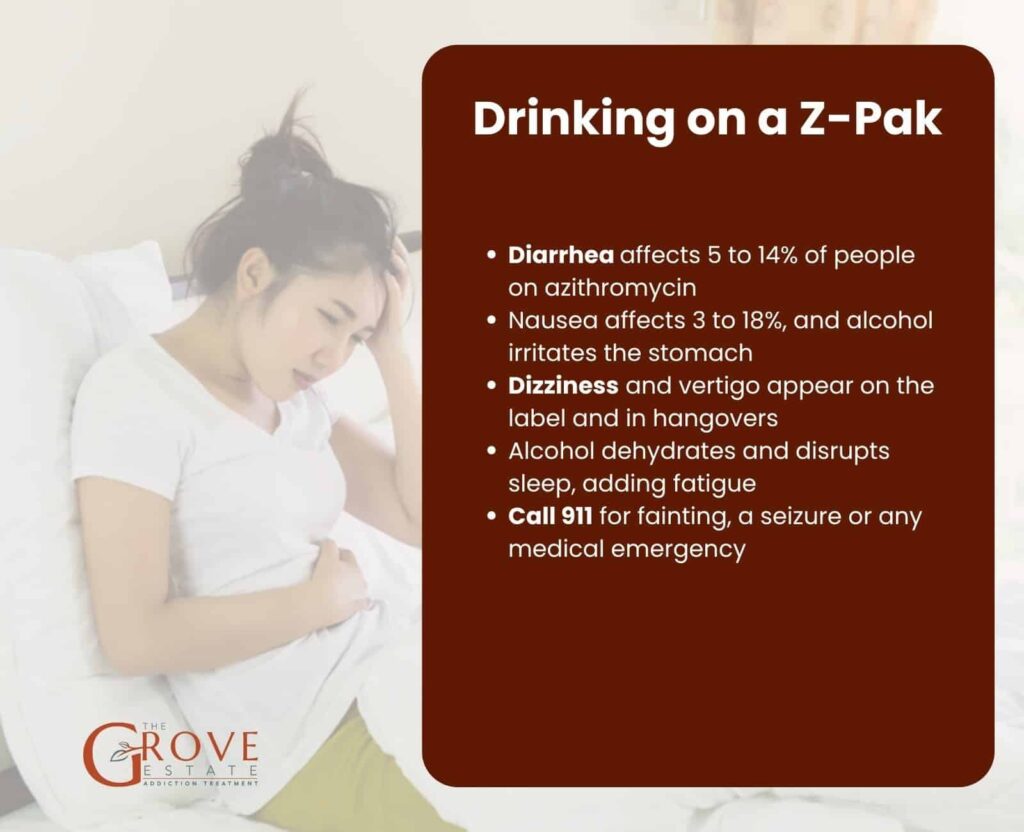
Drinking on a Z-Pak stacks alcohol’s stomach irritation, dehydration and poor sleep on top of azithromycin’s side effects, without any chemical reaction between the two. The most common azithromycin side effects are diarrhea, nausea and abdominal pain.
Contact us today to schedule an initial assessment or to learn more about our services. Whether you are seeking rehab treatment or simply need guidance on your recovery journey, we are here to help.
Common Side Effects
The Zithromax label reports diarrhea in 5 to 14% of patients, nausea in 3 to 18%, abdominal pain in 3 to 7% and vomiting in 2 to 7%. The label also lists dizziness, headache and fatigue among azithromycin adverse reactions.
There are 4 ways alcohol adds to azithromycin side effects, according to the NIAAA hangover fact sheet:
- Stomach irritation: Alcohol irritates the stomach lining and increases acid release, which produces nausea and stomach discomfort.
- Dehydration: Alcohol suppresses vasopressin, a brain hormone that tells the kidneys to hold on to fluid, so alcohol increases urination and fluid loss.
- Disrupted sleep: Alcohol fragments sleep and causes earlier waking, which adds fatigue.
- Vertigo: Alcohol produces vertigo, a spinning sensation, as a hangover symptom, and the Zithromax label lists dizziness and vertigo as azithromycin reactions.
Rare but Serious Reactions
The Zithromax label carries 3 serious warnings that apply whether or not a person drinks:
- QT prolongation: The Zithromax label reports a prolonged QT interval, the heart’s electrical reset time, and torsades de pointes, a dangerous heart rhythm, with macrolides including azithromycin.
- Liver injury: The Zithromax label reports hepatitis, jaundice and liver failure with azithromycin, some fatal, and directs prescribers to stop azithromycin at the first signs of hepatitis. The 2020 Mergenhagen review also flags azithromycin as carrying a risk of liver toxicity.
- C. difficile diarrhea: Clostridioides difficile infection ranges from mild diarrhea to fatal colitis, and the label notes cases reported more than two months after antibiotic treatment.
The NIAAA names liver disease and abnormal heart rhythm among the medical conditions that drinking causes or worsens. The NIAAA advises people managing conditions that alcohol worsens not to drink at all, which gives anyone with a liver or heart rhythm problem a clear reason to skip alcohol during azithromycin treatment.
The Zithromax label tells patients to contact a provider right away for a fast or irregular heartbeat, dizziness or fainting. Call 911 for a medical emergency, such as fainting.
How Long After Taking Azithromycin Can You Drink Alcohol?
The Zithromax label sets no alcohol waiting period after azithromycin, so no fixed wait time applies. The label’s 68-hour terminal half-life still means the drug stays in the body for days after the last tablet.
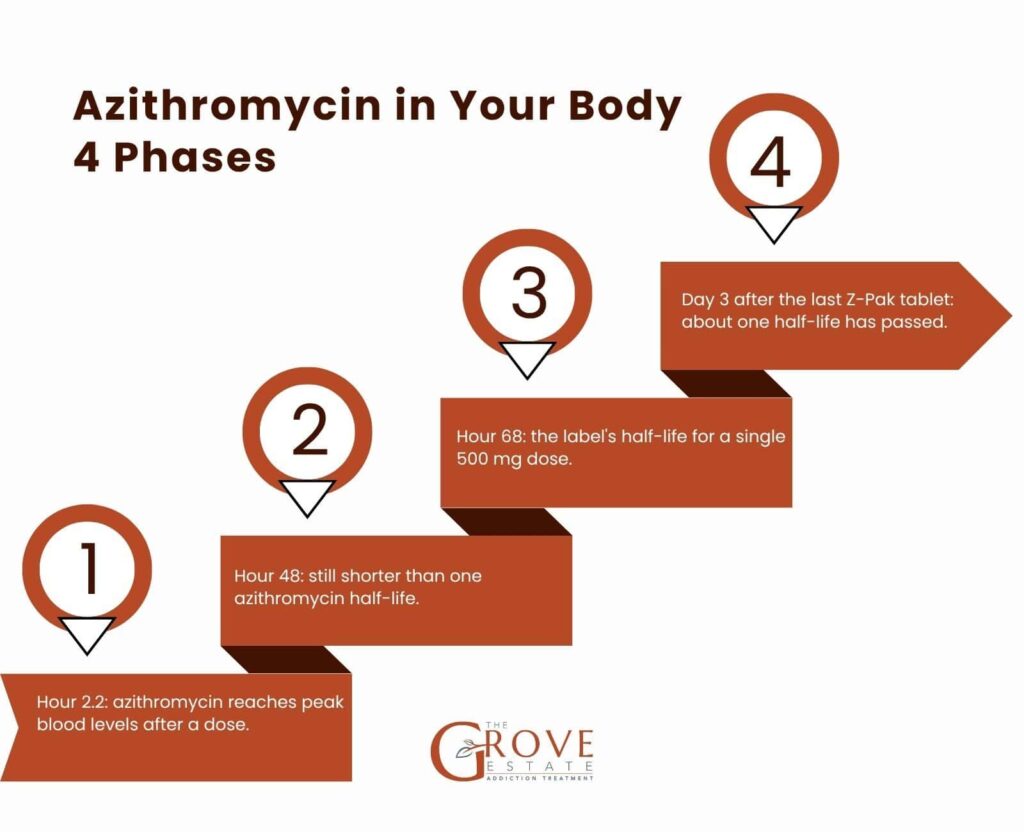
Half-life is the time the body takes to clear half of a drug. The Zithromax label measured a 68-hour terminal half-life after a single 500 mg dose and attributes that long half-life to azithromycin entering body tissues and releasing back out slowly.
A rule that 48 hours clears azithromycin does not match the label, because 48 hours is shorter than a single azithromycin half-life. A morning dose followed by an evening drink does not separate the two either, since azithromycin reaches peak blood levels about 2.2 hours after a dose and lingers for days.
The table below compares 3 common adult oral regimens in the Zithromax label and the serum half-life the label reports for each one:
| Regimen | Doses | Last dose | Label half-life | Label alcohol wait |
|---|---|---|---|---|
| 5-day Z-Pak | 500 mg on day 1, then 250 mg on days 2 to 5 (1500 mg total) | Day 5 | 68.9 hours | None stated |
| 3-day course | 500 mg once daily for 3 days (1500 mg total) | Day 3 | 71.8 hours | None stated |
| Single dose | 1 g once, used for chlamydia and other urethritis or cervicitis | Day 1 | 68 hours after a single 500 mg dose; not reported separately for 1 g | None stated |
The Zithromax label measured the 5-day and 3-day half-lives in 12 healthy adults. The 7-day figure many people attach to azithromycin comes from a different source entirely.
Are you covered for treatment?
The Grove Estate is in-network with Blue Cross Blue Shield and Physicians Health Plan of Northern Indiana, and accepts other commercial plans, such as Cigna and UnitedHealthcare, on an out-of-network basis.
Check Coverage Now!Why Do People Say to Wait 7 Days After Azithromycin?
The 7-day wait comes from CDC chlamydia guidance about sex, not an alcohol rule. The CDC 2021 STI Treatment Guidelines tell people treated for chlamydia with single-dose therapy to abstain from sexual intercourse for 7 days.
The CDC lists doxycycline 100 mg twice a day for 7 days as the recommended chlamydia regimen and azithromycin 1 g in a single dose as an alternative. People on the 7-day doxycycline course abstain from sex until the course ends and any symptoms resolve.
The CDC recommends azithromycin 1 g as the chlamydia regimen during pregnancy and lists doxycycline as contraindicated in the second and third trimesters. The NIAAA advises people who are pregnant or planning a pregnancy not to drink at all.
Mergenhagen and colleagues reported that doxycycline and alcohol may be combined, though doxycycline may work less well in people with long-term heavy alcohol use. The CDC also advises retesting about 3 months after chlamydia treatment.
Common misconception: Azithromycin requires 7 alcohol-free days after the dose, a rule that appears in neither the Zithromax label nor CDC guidance.
What the evidence shows: The CDC 2021 STI Treatment Guidelines set 7 days of sexual abstinence after single-dose chlamydia therapy, and the Zithromax label states no alcohol waiting period at all.
How Is Azithromycin Different From Metronidazole With Alcohol?
Metronidazole carries a labeled alcohol warning and azithromycin does not. The Flagyl label links metronidazole to a disulfiram-like reaction and tells patients to avoid alcohol during treatment and for at least three days after.
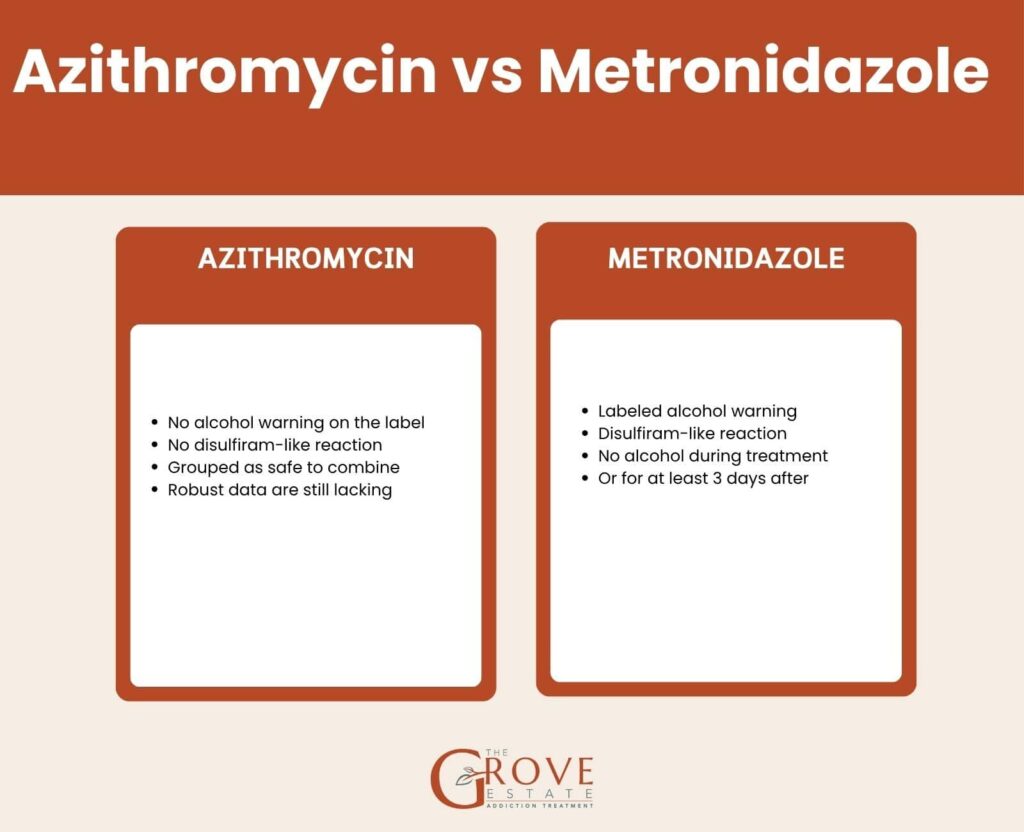
The Flagyl label lists abdominal cramps, nausea, vomiting, headaches and flushing as signs of the disulfiram-like reaction. Mergenhagen and colleagues found that the reaction between alcohol and metronidazole occurs with uncertain frequency and varied severity.
Erythromycin, a macrolide antibiotic in the same family as azithromycin, is the macrolide the 2020 review advises keeping away from alcohol. Peak blood alcohol levels averaged 40% higher with intravenous erythromycin than with placebo in a study of 10 people.
Cephalosporins with an MTT side chain, ketoconazole and griseofulvin also carry a higher risk of the disulfiram-like reaction, according to Mergenhagen and colleagues. The 2020 review sorts the wider evidence on alcohol and antibiotics into drugs to avoid and drugs safe to combine, and azithromycin falls in the second group.
When Does Drinking Through a Course of Antibiotics Signal a Bigger Problem?
Drinking through an antibiotic course signals a bigger problem when a person keeps drinking although alcohol adds to another health problem. That pattern is one of the NIAAA screening questions for alcohol use disorder (AUD).
The NIAAA defines alcohol use disorder (AUD) as a medical condition marked by an impaired ability to stop or control drinking despite social, work or health consequences. Clinicians rate AUD as mild with 2 to 3 criteria, moderate with 4 to 5 and severe with 6 or more.
The NIAAA lists alcohol withdrawal symptoms, such as shakiness, sweating, a racing heart or a seizure as alcohol wears off, among the signs of AUD. Call 911 for a seizure or any other medical emergency.
The Grove Estate in Peru, Indiana, provides residential alcohol rehab in Indiana for adults 18 and older, with physician-directed medication and 24-hour nursing oversight.
“In our 24-hour residential setting, nurses monitor each resident’s medical condition while our medical provider reviews every medication, antibiotics included. That oversight matters most during withdrawal management, when prescriptions still need to be taken on schedule.”
Ryan Cowles, BSN, Director of Nursing, The Grove Estate
People who need to stop drinking safely first can start with the residential detox program at The Grove Estate, delivered as withdrawal management within residential treatment.
Rediscover Life at The Grove Estate
Get the compassionate mental health support you deserve. We're here to help you reclaim joy, wellness, and a brighter future.
Our Facility
Frequently Asked Questions
Can I drink alcohol with azithromycin 500 mg?
Yes, azithromycin 500 mg has no documented alcohol interaction in the Zithromax label. The 500 mg tablet is the day 1 dose of a Z-Pak and the daily dose of the 3-day course.
Can I drink alcohol with azithromycin 250 mg?
Yes, azithromycin 250 mg, taken on days 2 to 5 of a Z-Pak, carries no labeled alcohol interaction. Alcohol still adds nausea and stomach irritation to the side effects azithromycin produces.
Did you know most health insurance plans cover substance use disorder treatment? Check your coverage online now.
If I take azithromycin in the morning, can I drink at night?
Morning dosing does not separate azithromycin from evening alcohol, because the 68-hour half-life keeps the drug in the body around the clock. No interaction is documented, so the concern is stacked side effects.
Can I drink 24 hours after taking azithromycin?
Azithromycin remains in the body 24 hours after a dose, since its half-life is 68 hours. The Zithromax label sets no alcohol wait, so drinking at 24 hours carries the same side-effect overlap as drinking mid-course.
Can you drink 3 days after a Z-Pak?
Three days after the last Z-Pak tablet, roughly one azithromycin half-life has passed, so some drug remains. The Zithromax label documents no interaction and gives no alcohol wait for this point or any other.
Contact us today to schedule an initial assessment or to learn more about our services. Whether you are seeking rehab treatment or simply need guidance on your recovery journey, we are here to help.
Can I drink milk with azithromycin?
Yes, milk is fine with azithromycin. The Zithromax label says the tablets work with or without food and lists no dairy restriction, but it warns against taking aluminum or magnesium antacids at the same time.
Is a Z-Pak the same as azithromycin?
Yes, a Z-Pak is Pfizer’s 6-tablet pack of Zithromax 250 mg, the brand name of azithromycin. The Zithromax label lists the 3-day 500 mg version as a Tri-Pak of 3 tablets.
Can one glass of wine hurt?
One glass of wine triggers no documented reaction with azithromycin. The NIAAA counts 5 ounces of 12% wine as one standard drink and advises that, for people who drink, less alcohol is better.
Are you covered for treatment?
The Grove Estate is in-network with Blue Cross Blue Shield and Physicians Health Plan of Northern Indiana, and accepts other commercial plans, such as Cigna and UnitedHealthcare, on an out-of-network basis.
Check Coverage Now!References
- Pfizer Laboratories. (2026). Zithromax (azithromycin) tablets and oral suspension [Prescribing information]. DailyMed, U.S. National Library of Medicine.
- Mergenhagen, K. A., Wattengel, B. A., Skelly, M. K., Clark, C. M., & Russo, T. A. (2020). Fact versus fiction: A review of the evidence behind alcohol and antibiotic interactions. Antimicrobial Agents and Chemotherapy, 64(3), e02167-19.
- Centers for Disease Control and Prevention. (2021). Chlamydial infections. Sexually Transmitted Infections Treatment Guidelines, 2021.
- Pfizer Laboratories. (2026). Flagyl (metronidazole) capsules [Prescribing information]. DailyMed, U.S. National Library of Medicine.
- National Institute on Alcohol Abuse and Alcoholism. (2014). Harmful interactions: Mixing alcohol with medicines (NIH Publication No. 13-5329).
- National Institute on Alcohol Abuse and Alcoholism. (n.d.). Basics: Defining how much alcohol is too much. NIAAA Core Resource on Alcohol.
- National Institute on Alcohol Abuse and Alcoholism. (2025). Hangovers [Fact sheet].
- National Institute on Alcohol Abuse and Alcoholism. (2025). Alcohol’s effects on the body.
- National Institute on Alcohol Abuse and Alcoholism. (2025). Understanding alcohol use disorder [Fact sheet].
Share This Post

The Grove Editorial Team
All author posts
ADDICTION TREATMENTS IN INDIANA
Are you covered for treatment?







The Grove Estate is in-network with Blue Cross Blue Shield and Physicians Health Plan of Northern Indiana, and accepts other commercial plans, such as Cigna and UnitedHealthcare, on an out-of-network basis.
Check Coverage Now!