Cephalexin and Alcohol: Can You Drink on Keflex?

Cephalexin and alcohol do not trigger a known chemical reaction, and NHS guidance states that people taking cephalexin (Keflex) can still drink alcohol. Alcohol still shares stomach side effects with the antibiotic, and heavy drinking weakens the immune system while the body is fighting an infection.
Cephalexin belongs to the cephalosporin family, and a few cephalosporins do react badly with alcohol because of a specific chemical side chain. Cephalexin lacks that side chain, which is why its FDA-approved label lists no alcohol interaction. The label names only metformin and probenecid as cephalexin drug interactions.
Whether alcohol weakens cephalexin, which side effects overlap and how long to wait all depend on how quickly cephalexin leaves the body. Drinking during a urinary tract infection (UTI) raises its own questions. Drinking that continues through every antibiotic course can also point to alcohol use disorder (AUD).
Key Takeaways
- Cephalexin, sold under the brand name Keflex, carries no alcohol interaction on its FDA-approved label, which lists metformin and probenecid as its drug interactions.
- A 2020 review by Mergenhagen and colleagues found that cephalosporins with an MTT side chain or MTDT ring raise the risk of a disulfiram-like reaction, a sweating, racing-heart response to alcohol.
- Cephalexin leaves the body fast: over 90% of a dose passes unchanged into the urine within 8 hours.
- Diarrhea is the most frequent side effect of cephalexin, and alcohol damages the lining of the gut.
- Drinking a lot on one occasion slows the body’s ability to fight infection for up to 24 hours, according to the National Institute on Alcohol Abuse and Alcoholism (NIAAA).
Did you know most health insurance plans cover substance use disorder treatment? Check your coverage online now.
Can You Drink Alcohol While Taking Cephalexin?
Yes, people taking cephalexin can drink alcohol, because the cephalexin label lists no alcohol interaction and NHS guidance states that people taking cefalexin can still drink alcohol. Cefalexin is the UK spelling of cephalexin.
The FDA-approved cephalexin label names two drug interactions: metformin and probenecid. Alcohol does not appear anywhere in the cephalexin label. Walgreens, Rite Aid and CVS issued no alcohol warning for cephalexin when the 2020 Mergenhagen review compared pharmacy labels.
NIAAA advises some people to avoid alcohol completely, including anyone younger than 21, pregnant, or unable to control the amount they drink. People who cannot stop drinking even for the length of a cephalexin course can get help through alcohol rehab in Indiana. Cephalexin’s chemical structure also differs from the cephalosporins that react with alcohol.
Why Doesn’t Cephalexin React With Alcohol Like Some Other Antibiotics?
Cephalexin does not react with alcohol because it lacks the MTT side chain and MTDT ring that link certain cephalosporins to disulfiram-like reactions. The 2020 Mergenhagen review found that cephalosporins without these side chains appear safe to consume with alcohol.
A methylthiotetrazole (MTT) side chain resembles part of the disulfiram molecule, according to Mergenhagen 2020. Disulfiram is an FDA-approved medication that helps people with AUD stop or reduce drinking. PubChem’s chemical name for cephalexin shows a plain methyl group in that position, with neither the MTT side chain nor the MTDT ring.
A retrospective Chinese review cited by Mergenhagen 2020 examined 78 disulfiram-like reactions to intravenous cephalosporins. Palpitations occurred in 78% of patients and sweating in 63%, and five patients died. Those reactions involved injected cephalosporins, not oral cephalexin.
The following table compares cephalexin with antibiotics that carry an alcohol warning, using the drug labels and the 2020 Mergenhagen review.
| Antibiotic | Drug group | Chemical feature | Alcohol guidance |
|---|---|---|---|
| Cephalexin (Keflex) | Oral cephalosporin | No MTT side chain, no MTDT ring | No alcohol interaction on the label; NHS states drinking is allowed |
| Cefotetan, cefoperazone, cefamandole, cefmetazole | Cephalosporins | MTT side chain | Avoid alcohol (disulfiram-like reaction) |
| Ceftriaxone (IV or IM injection) | Cephalosporin | MTDT ring | Avoid alcohol (disulfiram-like reaction, which may be severe) |
| Metronidazole (Flagyl) | Nitroimidazole | Not a cephalosporin | No alcohol during treatment and for at least 3 days after |
| Tinidazole | Nitroimidazole | Not a cephalosporin | Label advises avoiding alcohol within 72 hours |
The Flagyl label links metronidazole to abdominal cramps, nausea, vomiting, headaches and flushing with alcohol. That warning makes metronidazole and alcohol a riskier pairing than cephalexin and alcohol.
Do All Antibiotics React Badly With Alcohol?
Common misconception: every antibiotic reacts with alcohol or stops working when you drink.
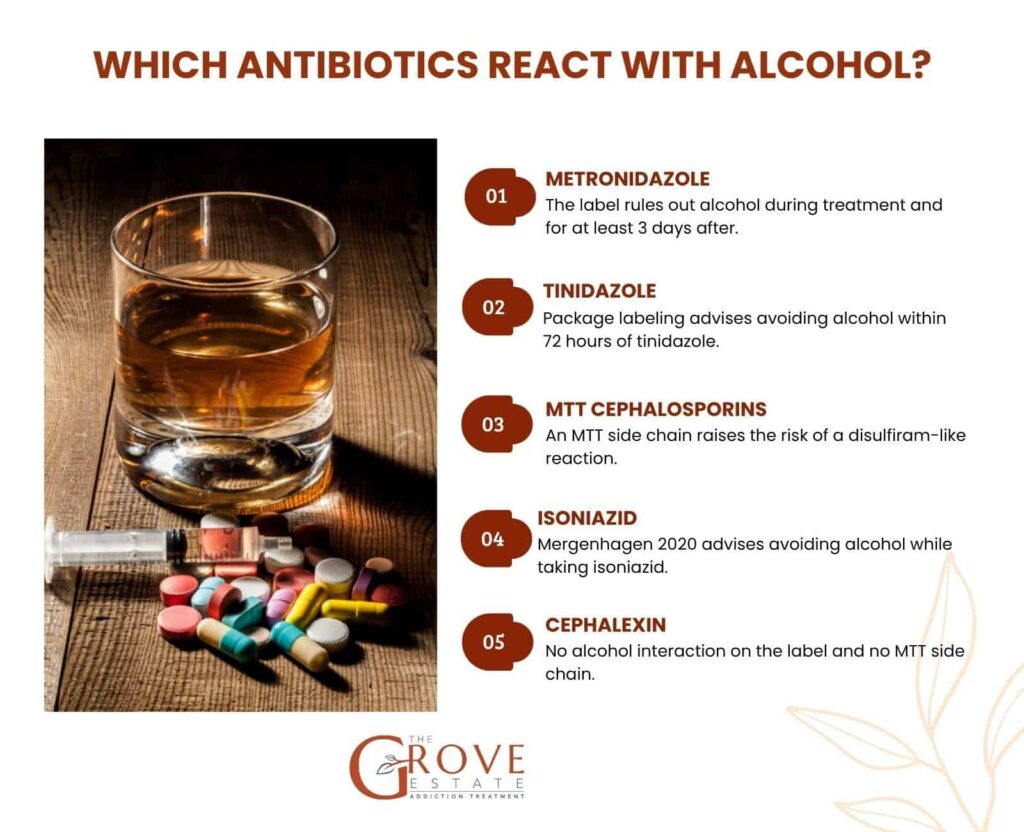
What the evidence shows: Mergenhagen and colleagues wrote in their 2020 review “Fact versus Fiction” that the evidence behind these beliefs is poor and controversial. The safety of drinking alcohol with antibiotics depends on the specific drug, not on antibiotics as a group.
Contact us today to schedule an initial assessment or to learn more about our services. Whether you are seeking rehab treatment or simply need guidance on your recovery journey, we are here to help.
Does Alcohol Make Cephalexin Less Effective?
Alcohol has not been shown to make cephalexin less effective in any human study. The only cephalexin data come from one rat study, in which acute alcohol lowered cephalexin absorption and urinary excretion, while chronic alcohol exposure had no significant effect.
The 2020 Mergenhagen review lists no human efficacy data for cephalexin and alcohol. Human data exist for amoxicillin and alcohol: according to Mergenhagen 2020, alcohol slows how fast the body absorbs amoxicillin, a penicillin, but not how much it absorbs.
Heavy drinking weakens the immune system rather than the cephalexin itself. NIAAA states that drinking a lot on a single occasion slows the body’s ability to ward off infections for up to 24 hours. Alcohol’s effects on the gut also overlap with the side effects of cephalexin.
What Side Effects Get Worse When You Mix Cephalexin and Alcohol?
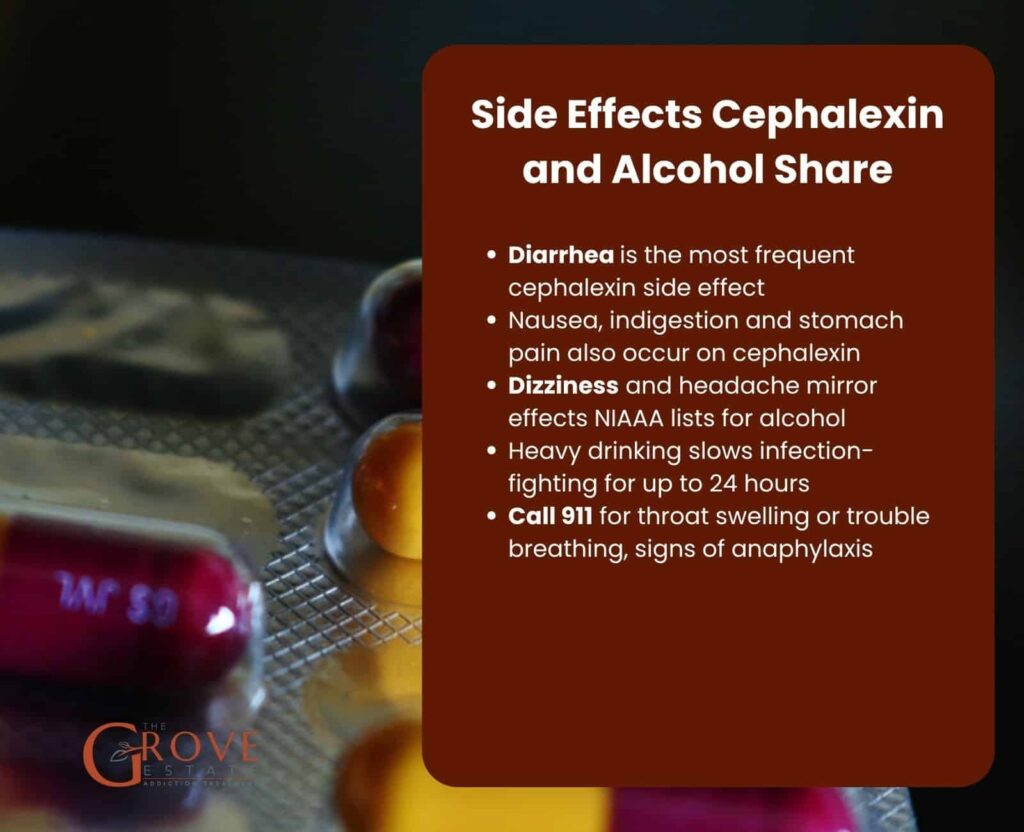
The side effects that overlap most are gut side effects such as diarrhea, because diarrhea is the most frequent cephalexin side effect and alcohol damages the lining of the gastrointestinal tract, according to NIAAA. Nausea and stomach pain also occur with cephalexin. Dizziness and headache from cephalexin mirror the lightheadedness and headaches NIAAA lists for alcohol.
Common Side Effects
The cephalexin label lists 7 side effects that overlap with the effects of alcohol:
- Diarrhea: the most frequent cephalexin side effect in clinical trials; alcohol damages the lining of the gut.
- Nausea and vomiting: reported with cephalexin; NIAAA lists both as effects of mixing alcohol with certain medicines.
- Indigestion: listed on the cephalexin label as dyspepsia; NIAAA reports a higher risk of reflux disease with alcohol use.
- Stomach inflammation: listed on the cephalexin label as gastritis; alcohol promotes inflammation in the gut.
- Abdominal pain: reported in cephalexin clinical trials; NIAAA lists stomach pain as an alcohol reaction with some antibiotics.
- Dizziness: reported with cephalexin; NIAAA notes that alcohol makes people lightheaded.
- Headache: reported with cephalexin; NIAAA lists headaches as an effect of mixing alcohol with certain medicines.
Are you covered for treatment?
The Grove Estate is in-network with Blue Cross Blue Shield and Physicians Health Plan of Northern Indiana, and accepts other commercial plans, such as Cigna and UnitedHealthcare, on an out-of-network basis.
Check Coverage Now!Serious Reactions That Need Medical Care
Two serious reactions on the cephalexin label need prompt care:
- Clostridioides difficile diarrhea: C. difficile-associated diarrhea ranges from mild diarrhea to fatal colitis and can start over two months after the antibiotic. Contact your doctor for severe watery or bloody diarrhea.
- Allergic reaction: rash, hives, swelling of the face or throat (angioedema) and anaphylaxis, a severe whole-body allergic reaction, have been reported with cephalexin. Call 911 for trouble breathing or throat swelling.
Most people want to know how long these risks last, which depends on how fast cephalexin leaves the body.
How Long After Taking Cephalexin Can You Drink Alcohol?
The cephalexin label sets no waiting period before drinking, because the label lists no alcohol interaction. Over 90% of a cephalexin dose leaves the body unchanged in the urine within 8 hours, according to the FDA-approved label.
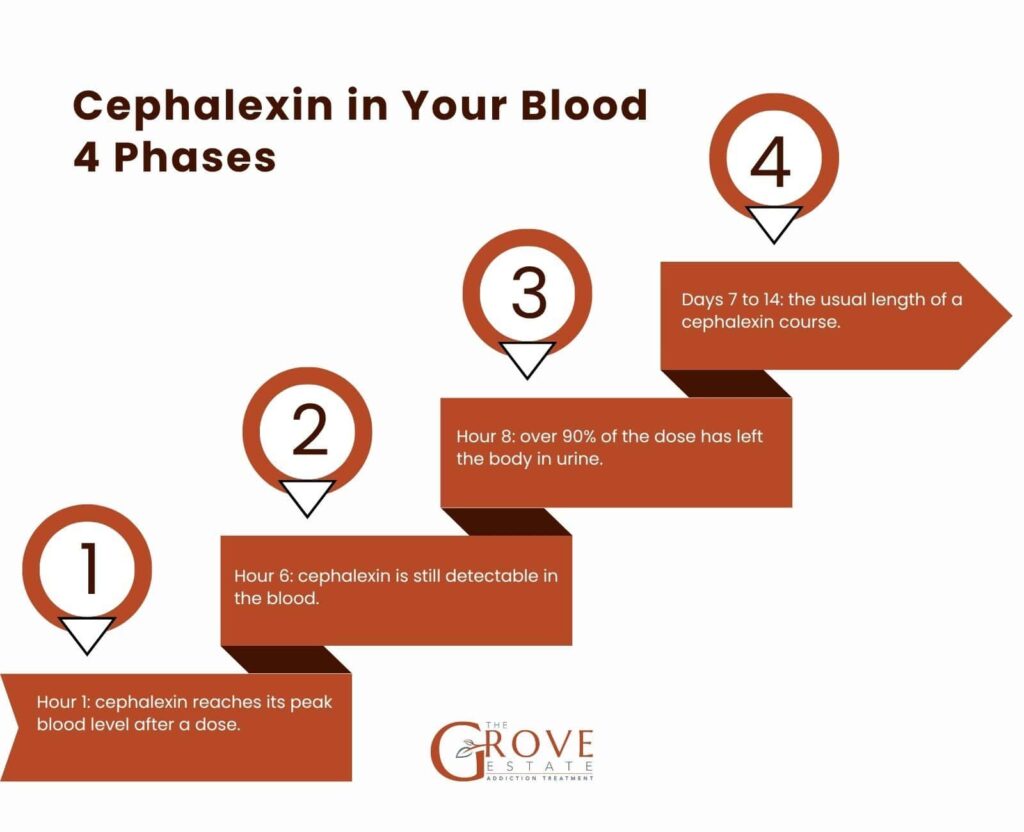
Cephalexin reaches its peak blood level at 1 hour, and blood levels remain detectable 6 hours after a dose.
The better timing question concerns the infection. NIAAA reports that heavy drinking on one occasion slows infection-fighting for up to 24 hours. NHS guidance advises telling your doctor if you do not feel better after 2 to 3 days of cefalexin, which matters most for a urinary tract infection.
Is It Safe to Drink on Cephalexin for a UTI?
Drinking on cephalexin for a UTI carries no drug interaction, but heavy drinking slows the immune response that clears the infection. The FDA-approved cephalexin label lists cephalexin for genitourinary infections caused by E. coli, Proteus mirabilis and Klebsiella pneumoniae.
The cephalexin label sets a course of 7 to 14 days depending on the infection type and severity. The label warns that skipping doses or stopping early decreases cephalexin’s effectiveness and raises the chance of resistant bacteria.
Taking every cephalexin dose on time protects UTI treatment, according to the label’s warning on skipped doses. Cephalexin also has a few drug and lab interactions to know about.
Rediscover Life at The Grove Estate
Get the compassionate mental health support you deserve. We're here to help you reclaim joy, wellness, and a brighter future.
Our Facility
What Else Should You Avoid While Taking Cephalexin?
Avoid probenecid, and ask your doctor about metformin, because the cephalexin label lists both as drug interactions. Food is not a concern: the label states that cephalexin may be given without regard to meals.
The cephalexin label lists 3 interactions to avoid or manage:
- Probenecid: probenecid blocks cephalexin’s removal through the kidneys, so the label does not recommend combining them.
- Metformin: metformin blood levels rise with cephalexin, so the label advises monitoring for low blood sugar.
- Urine glucose tests: cephalexin can give a false-positive result on urine sugar tests that use Benedict’s or Fehling’s solution.
NHS guidance confirms that people taking cefalexin can eat and drink normally. Repeated questions about drinking during a short antibiotic course point to a larger question about alcohol use.
When Does Drinking During Antibiotics Point to Alcohol Use Disorder?
Drinking during antibiotics points to AUD when a person cannot stop or control drinking despite health consequences. NIAAA defines alcohol use disorder (AUD) as an impaired ability to stop or control alcohol use despite adverse social, occupational or health consequences.
NIAAA names the AUDIT-C as one of two brief screening tools recommended by the U.S. Preventive Services Task Force. The AUDIT-C asks 3 questions:
- How often did you have a drink containing alcohol in the past year?
- On days in the past year when you drank alcohol, how many drinks did you typically have?
- How often did you have 6 or more drinks on one occasion in the past year?
NIAAA explains that clinicians rate AUD by DSM-5 criteria as mild (2 to 3 criteria), moderate (4 to 5) or severe (6 or more). NIAAA lists shakiness, sweating, nausea, a racing heart and seizure among alcohol withdrawal symptoms.
The Grove Estate treats adults 18 and older with AUD in a residential setting in Peru, Indiana. The Grove Estate’s residential detox in Indiana provides withdrawal management within residential treatment, with 24-hour nursing oversight and physician-directed medication.
“When a client arrives at The Grove Estate partway through an antibiotic such as cephalexin, our nurses review that prescription alongside the physician-directed medication plan. Around-the-clock nursing oversight lets us keep every dose on schedule while the client goes through withdrawal management.”
Ryan Cowles, BSN, Director of Nursing, The Grove Estate
Frequently Asked Questions
Did you know most health insurance plans cover substance use disorder treatment? Check your coverage online now.
Is cephalexin 500 mg a strong antibiotic?
Cephalexin 500 mg is a standard adult dose, not an unusually strong one. The FDA label lists 250 mg every 6 hours or 500 mg every 12 hours as usual adult dosing, with capsules from 250 mg to 750 mg.
Can you have one beer on cephalexin?
Yes, one beer does not react with cephalexin. NHS guidance states that people taking cefalexin can still drink alcohol, and NIAAA counts a 12-ounce regular beer at 5% alcohol as one standard drink.
Can you drink wine with cephalexin?
Yes, wine does not react with cephalexin any differently from beer. NIAAA counts a 5-ounce glass of wine at 12% alcohol as one standard drink, the same 14 grams of alcohol as a regular beer.
Contact us today to schedule an initial assessment or to learn more about our services. Whether you are seeking rehab treatment or simply need guidance on your recovery journey, we are here to help.
Are Keflex and cephalexin the same?
Yes, Keflex is the brand name of cephalexin, an oral cephalosporin antibiotic. DailyMed lists Keflex as cephalexin capsules, and NHS guidance names Keflex as the brand name of cefalexin.
Is cephalexin a penicillin?
No, cephalexin is a cephalosporin, not a penicillin. Both belong to the beta-lactam antibiotic family, and the cephalexin label warns that cross-allergy may occur in up to 10% of people with a penicillin allergy history.
What antibiotics can you not drink with?
Avoid alcohol with metronidazole, tinidazole, injected ceftriaxone and the MTT cephalosporins cefotetan, cefoperazone, cefamandole and cefmetazole. Mergenhagen 2020 also advises avoiding alcohol with isoniazid.
Are you covered for treatment?
The Grove Estate is in-network with Blue Cross Blue Shield and Physicians Health Plan of Northern Indiana, and accepts other commercial plans, such as Cigna and UnitedHealthcare, on an out-of-network basis.
Check Coverage Now!What should you do if you already drank on cephalexin?
Keep taking cephalexin on schedule and finish the course, as the FDA label and NHS guidance advise. Call 911 for throat swelling or trouble breathing at any point, because the cephalexin label lists anaphylaxis, a severe allergic reaction.
References
- A-S Medication Solutions. (2026). Cephalexin capsules, USP [Prescribing information; manufactured by Alkem Laboratories, revised January 2025]. DailyMed, U.S. National Library of Medicine. https://dailymed.nlm.nih.gov/dailymed/lookup.cfm?setid=73920373-b45d-45d6-b183-d962467dde36
- Advancis Pharmaceutical Corporation. (2008). Keflex (cephalexin) capsules [Prescribing information]. DailyMed, U.S. National Library of Medicine.
- Mergenhagen, K. A., Wattengel, B. A., Skelly, M. K., Clark, C. M., & Russo, T. A. (2020). Fact versus fiction: A review of the evidence behind alcohol and antibiotic interactions. Antimicrobial Agents and Chemotherapy, 64(3), e02167-19. https://pmc.ncbi.nlm.nih.gov/articles/PMC7038249/
- Pfizer Laboratories. (2026). Flagyl (metronidazole) capsules [Prescribing information]. DailyMed, U.S. National Library of Medicine.
- National Center for Biotechnology Information. (n.d.). PubChem compound summary for CID 27447, cephalexin. National Library of Medicine.
- National Health Service. (2023). Common questions about cefalexin. NHS.
- National Institute on Alcohol Abuse and Alcoholism. (n.d.). Harmful interactions: Mixing alcohol with medicines. https://www.niaaa.nih.gov/publications/brochures-and-fact-sheets/harmful-interactions-mixing-alcohol-with-medicines
- National Institute on Alcohol Abuse and Alcoholism. (2025). Alcohol’s effects on the body. National Institutes of Health.
- National Institute on Alcohol Abuse and Alcoholism. (2025). What is a standard drink? National Institutes of Health.
- National Institute on Alcohol Abuse and Alcoholism. (2026). Understanding alcohol drinking patterns. National Institutes of Health.
- National Institute on Alcohol Abuse and Alcoholism. (2025). Understanding alcohol use disorder. National Institutes of Health.
- National Institute on Alcohol Abuse and Alcoholism. (n.d.). Screen and assess: Use quick, effective methods. The Healthcare Professional’s Core Resource on Alcohol.
Share This Post

The Grove Editorial Team
All author posts
ADDICTION TREATMENTS IN INDIANA
Are you covered for treatment?







The Grove Estate is in-network with Blue Cross Blue Shield and Physicians Health Plan of Northern Indiana, and accepts other commercial plans, such as Cigna and UnitedHealthcare, on an out-of-network basis.
Check Coverage Now!