Cyclobenzaprine and Alcohol: How Long Should You Wait?

Cyclobenzaprine and alcohol should not be combined, because the FDA labels for this prescription muscle relaxer warn that cyclobenzaprine may enhance the effects of alcohol. Cyclobenzaprine, known by the brand names Flexeril and Amrix, already causes drowsiness and dizziness on its own.
The safe wait before drinking depends on the form of cyclobenzaprine, the length of the course, age and liver health. Cyclobenzaprine leaves the body slowly, so the estimated wait runs to days rather than hours. Every waiting time in this article is an estimate to confirm with a prescriber or pharmacist.
The combination turns more dangerous when it slows breathing, or when opioids, benzodiazepines or serotonergic drugs join it. Knowing the warning signs, and when to call 911 or Poison Control, matters for anyone who has already mixed the two. Drinking that continues despite these warnings can also point to alcohol use disorder (AUD).
Key Takeaways
- The FDA label for cyclobenzaprine hydrochloride tablets states that cyclobenzaprine may enhance the effects of alcohol, barbiturates and other CNS depressants (drugs that slow the brain and nervous system).
- Immediate-release cyclobenzaprine has an effective half-life of 18 hours (range 8 to 37 hours), and extended-release Amrix has a half-life of 32 hours that rises to 50 hours in adults over 65.
- Cyclobenzaprine tablets taken three times a day build up in the blood, reaching levels about four-fold higher than a single dose within 3 to 4 days.
- The rule of thumb that about five half-lives clear a drug gives an estimated 90 hours for immediate-release cyclobenzaprine, an estimate to confirm with the prescriber or pharmacist.
- The National Institute on Alcohol Abuse and Alcoholism (NIAAA) lists slowed or difficult breathing, higher overdose risk and impaired motor control as reactions when alcohol mixes with cyclobenzaprine (Flexeril).
Did you know most health insurance plans cover substance use disorder treatment? Check your coverage online now.
Can You Drink Alcohol While Taking Cyclobenzaprine?
No, you should not drink alcohol while taking cyclobenzaprine, because the FDA label warns that cyclobenzaprine may enhance the effects of alcohol. That combined effect with other CNS depressants deepens drowsiness and slows thinking and reaction time. The Amrix patient guide tells people not to drink alcohol until they know how the capsule acts on them.
Cyclobenzaprine is a skeletal muscle relaxant, and MedlinePlus explains that cyclobenzaprine acts in the brain and nervous system to let the muscles relax. The tablet label approves cyclobenzaprine as an add-on to rest and physical therapy for muscle spasm from acute, painful muscle and bone conditions.
The cyclobenzaprine tablet label states that cyclobenzaprine is closely related to the tricyclic antidepressants amitriptyline and imipramine. The Amrix label links the alcohol warning to that tricyclic structure, stating that Amrix may enhance the effects of alcohol, barbiturates and other CNS depressants based on its structural similarity to tricyclic antidepressants.
Why Is Cyclobenzaprine Dangerous to Mix With Alcohol?
Cyclobenzaprine is dangerous to mix with alcohol because the two depressants stack. The NIAAA list of harmful interactions shows the combination slows breathing, impairs motor control and memory, and raises the risk of seizures and overdose.
There are 7 reactions the NIAAA lists when alcohol mixes with cyclobenzaprine:
- Drowsiness
- Dizziness
- Higher seizure risk
- Higher overdose risk
- Slowed or difficult breathing
- Impaired motor control
- Memory problems and unusual behavior
The tablet label warns that cyclobenzaprine, especially with alcohol or other CNS depressants, may impair the mental and physical abilities needed to drive a car or operate machinery.
Drowsiness is the most frequent cyclobenzaprine side effect, reported by 39% of people taking 10 mg in the label’s clinical studies. The label states that cyclobenzaprine is eliminated quite slowly, so the half-life sets the wait before drinking.
How Long After Taking Cyclobenzaprine Can You Drink Alcohol?
Plan on about 90 hours after one immediate-release dose and about 160 hours after one Amrix dose, and longer after a multi-day course. That equals about 3.75 days and 6.7 days. These are estimates from the label half-lives and the five half-life rule, so confirm your wait with your prescriber or pharmacist.
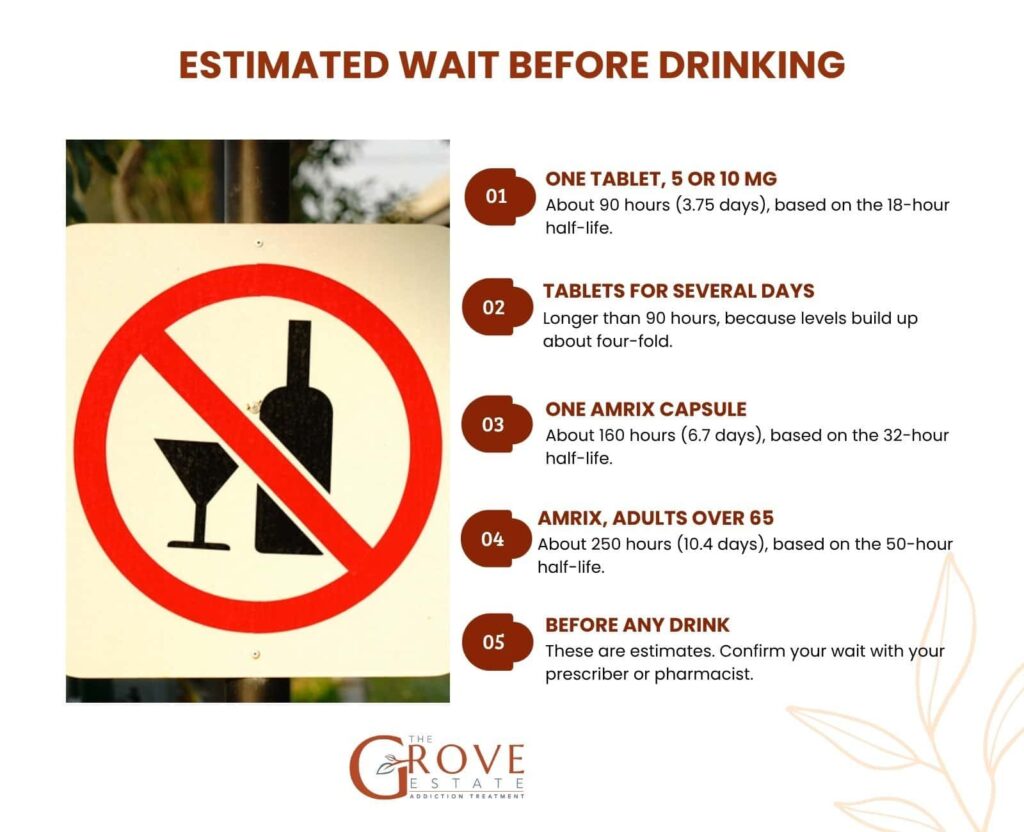
A half-life is the time the body takes to remove half of a drug. A 2014 review by Dincq and colleagues in BioMed Research International states that 96.9% of a drug is eliminated after 5 half-lives.
The following table lists the label half-life for each form of cyclobenzaprine, the estimated clearance time from the five half-life rule, and the extra detail each label adds.
| Form and situation | Label half-life | Estimated clearance (about 5 half-lives) | What the label adds |
|---|---|---|---|
| Immediate-release tablet, one 5 mg or 10 mg dose | 18 hours (range 8 to 37 hours) | About 90 hours (3.75 days); 40 to 185 hours across the label range | Linear kinetics from 2.5 mg to 10 mg, so both strengths share one half-life |
| Immediate-release tablets, three times a day for several days | 18 hours | Longer than 90 hours: levels start about four-fold higher, which adds about 2 half-lives (36 hours) by estimate | Steady state within 3 to 4 days at about four-fold the single-dose level |
| Amrix extended-release capsule, 15 mg or 30 mg once daily, adults 18 to 45 | 32 hours | About 160 hours (6.7 days) after one dose; longer after daily use, because levels build up | 2.5-fold buildup after 7 days of 30 mg once daily |
| Amrix extended-release capsule, adults over 65 | 50 hours | About 250 hours (10.4 days) | The Amrix label does not recommend Amrix for older adults |
Every number in the clearance column is an estimate from the five half-life rule of thumb, not a label instruction. Confirm the wait for your dose, age and liver health with the prescriber or pharmacist before drinking.
The same 18-hour average half-life sets how long cyclobenzaprine stays in your system after the last tablet.
Contact us today to schedule an initial assessment or to learn more about our services. Whether you are seeking rehab treatment or simply need guidance on your recovery journey, we are here to help.
Is One Day After the Last Pill Enough?
Common misconception: waiting 24 hours after the last cyclobenzaprine tablet makes drinking safe.
What the evidence shows: the cyclobenzaprine tablet label gives an 18-hour average half-life, so about 40% of a single dose remains after 24 hours by estimate. The same label reports four-fold buildup after 3 to 4 days of three daily doses, so a course leaves far more cyclobenzaprine behind. Confirm the wait with your prescriber or pharmacist.
Does a 5 mg Dose Leave Your System Faster Than 10 mg?
No, a 5 mg cyclobenzaprine dose does not leave the body faster, because the 18-hour half-life stays the same at both strengths. The tablet label reports linear pharmacokinetics from 2.5 mg to 10 mg.
Linear pharmacokinetics means cyclobenzaprine blood levels rise in proportion to the dose. A 10 mg tablet therefore produces about twice the cyclobenzaprine level of a 5 mg tablet, and that higher level takes the same number of hours to halve.
The cyclobenzaprine tablet label sets 5 mg three times a day as the usual dose and allows 10 mg three times a day based on individual response. The label advises less frequent dosing for older adults and people with liver impairment.
What Are the Warning Signs of a Dangerous Reaction?
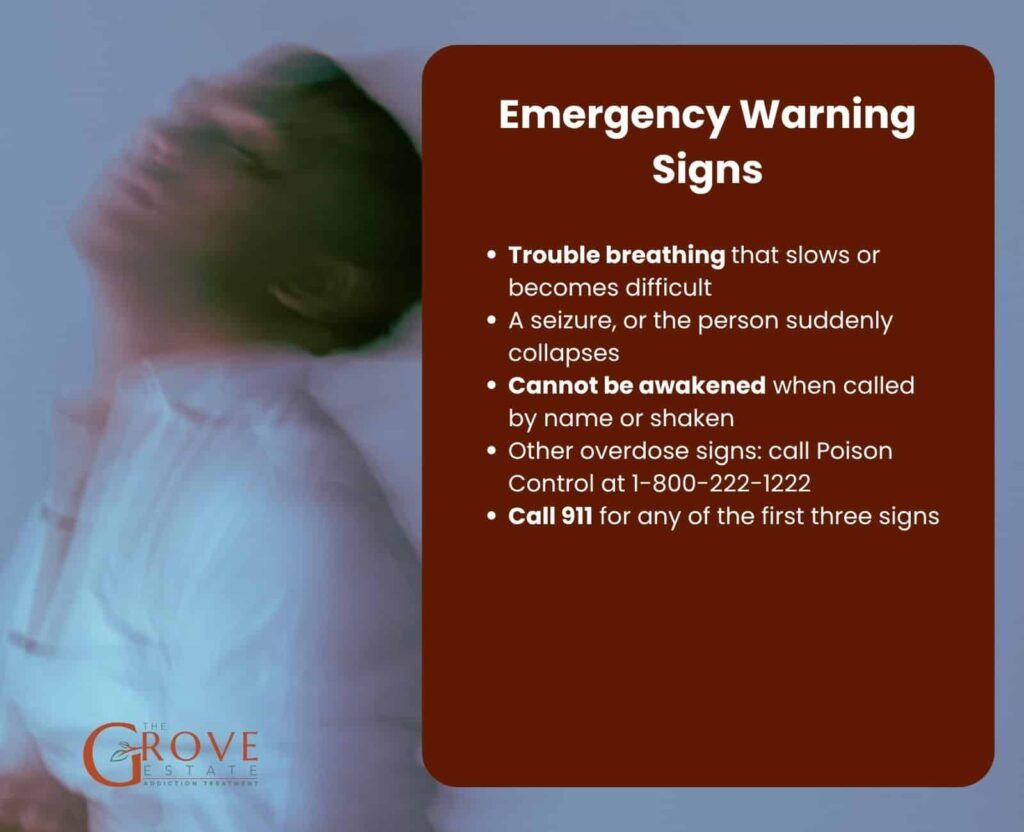
The warning signs of a dangerous reaction are trouble breathing, a seizure, collapse, being impossible to wake, a fast or irregular heartbeat, confusion and hallucinations. Call 911 for any of the first four.
Are you covered for treatment?
The Grove Estate is in-network with Blue Cross Blue Shield and Physicians Health Plan of Northern Indiana, and accepts other commercial plans, such as Cigna and UnitedHealthcare, on an out-of-network basis.
Check Coverage Now!Common Effects
There are 3 side effects the cyclobenzaprine tablet label reports most frequently:
- Drowsiness
- Dry mouth
- Dizziness
Alcohol adds to cyclobenzaprine drowsiness and dizziness, according to the NIAAA, and the Amrix patient guide states the combination slows thinking and physical response times.
Emergency Warning Signs
There are 4 emergency signs that require a 911 call, according to MedlinePlus:
- Trouble breathing: breathing that slows or becomes difficult, a reaction the NIAAA lists for cyclobenzaprine and alcohol.
- Seizure: a risk the NIAAA lists as higher when alcohol mixes with cyclobenzaprine.
- Collapse: the person suddenly falls down or passes out.
- Cannot be awakened: the person does not wake up when called by name or shaken.
Call Poison Control at 1-800-222-1222 about other overdose symptoms, which MedlinePlus lists as including a fast or irregular heartbeat, agitation, confusion, trouble speaking or moving, hallucinations, tremor and vomiting.
The cyclobenzaprine tablet label warns that signs of toxicity may develop rapidly after an overdose. Rare but critical overdose effects on the label include cardiac arrest, chest pain, seizures and severely low blood pressure.
Which Other Drugs Make Cyclobenzaprine and Alcohol More Dangerous?
Opioids, benzodiazepines, tramadol, SSRIs, SNRIs and MAO inhibitors make cyclobenzaprine and alcohol more dangerous. They either add sedation and slowed breathing or raise the risk of serotonin syndrome, seizures or a dangerously high fever.
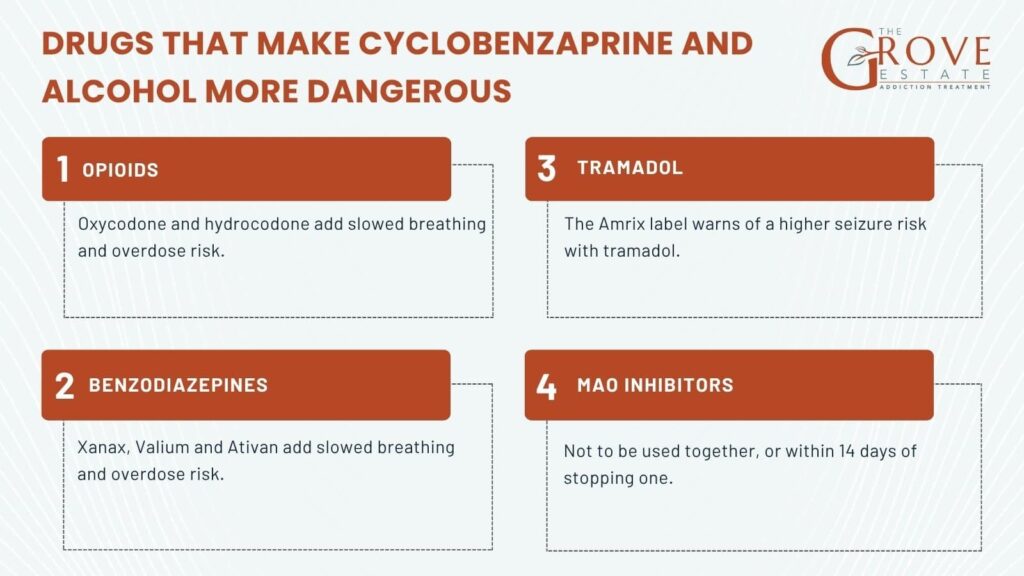
There are 5 drug groups that raise the danger of cyclobenzaprine and alcohol:
- Opioids: The NIAAA lists slowed or difficult breathing and higher overdose risk for mixing alcohol and oxycodone (Percocet), the same reactions it lists for cyclobenzaprine. Hydrocodone (Vicodin) carries the same NIAAA reactions.
- Benzodiazepines: The NIAAA lists slowed or difficult breathing and higher overdose risk for mixing alcohol and Xanax (alprazolam), diazepam (Valium) and lorazepam (Ativan).
- Tramadol: The Amrix label warns that cyclobenzaprine may enhance the seizure risk in people taking tramadol. Tramadol also appears on the cyclobenzaprine serotonin syndrome list.
- SSRIs, SNRIs and other serotonergic drugs: The tablet label reports life-threatening serotonin syndrome when cyclobenzaprine is combined with SSRIs, SNRIs, tricyclic antidepressants, tramadol, bupropion, meperidine or verapamil. Serotonin syndrome symptoms include confusion, agitation, a fast heartbeat, fever, tremor and muscle rigidity.
- MAO inhibitors: The tablet label contraindicates cyclobenzaprine, meaning it must not be used, with MAO inhibitors or within 14 days of stopping one. Hyperpyretic crisis (a dangerously high fever), seizures and deaths have occurred with this pairing.
Alcohol does not appear on the label’s serotonin syndrome list, so the serotonin danger comes from the medicine pairing itself. Those interaction risks weigh hardest on people whose bodies clear cyclobenzaprine slowly.
Rediscover Life at The Grove Estate
Get the compassionate mental health support you deserve. We're here to help you reclaim joy, wellness, and a brighter future.
Our Facility
Who Faces the Highest Risk From This Combination?
Adults over 65 and people with liver impairment face the highest risk from cyclobenzaprine and alcohol, because the labels show higher cyclobenzaprine blood levels in both groups. Women also reach higher blood alcohol levels than men, according to the NIAAA.
There are 4 higher-risk groups for cyclobenzaprine and alcohol:
- Adults 65 and older taking tablets: The tablet label reports cyclobenzaprine exposure about 1.7-fold higher in adults 65 and older, and about 2.4-fold higher in older men. Exposure means the total amount of drug in the blood over time.
- Adults over 65 taking Amrix: The Amrix label reports 40% higher exposure and a 50-hour half-life in adults over 65. The Amrix label does not recommend Amrix for older adults.
- People with liver impairment: The tablet label found cyclobenzaprine exposure and peak levels about double normal in 16 people with mostly mild liver impairment. The Amrix label does not recommend Amrix in mild, moderate or severe liver impairment.
- Women: The NIAAA states that women, in general, have a higher risk for alcohol problems than men. The same amount of alcohol typically produces a higher blood alcohol level in a woman than in a man, according to the NIAAA.
Older adults face a second layer of risk, because the NIAAA states that aging slows the body’s ability to break down alcohol. The NIAAA also reports that alcohol and medicine combinations produce falls and serious injuries, especially among older people.
When Does Mixing Muscle Relaxers and Alcohol Become a Substance Use Problem?
Mixing muscle relaxers and alcohol becomes a substance use problem when a person cannot stop or control drinking despite the harm. NIAAA defines alcohol use disorder (AUD) as an impaired ability to stop or control drinking despite adverse social, occupational or health consequences.
The NIAAA defines AUD as a medical condition marked by an impaired ability to stop or control alcohol use despite social, work or health consequences. AUD ranges from mild to moderate to severe, and evidence-based treatment helps people with AUD reach and keep recovery.
The cyclobenzaprine labels limit use to short periods of up to two or three weeks. The labels also state that multiple drug ingestion, including alcohol, is common in deliberate cyclobenzaprine overdose.
The label for methocarbamol, another muscle relaxer, cautions patients about the combined effects of methocarbamol and alcohol and other CNS depressants.
The Grove Estate provides residential addiction treatment in Peru, Indiana, with withdrawal management within residential treatment, 24-hour nursing oversight and physician-directed medication. Adults whose drinking continues despite medication warnings can start care with alcohol detox in Indiana at The Grove Estate.
Treatment for AUD then continues in luxury alcohol rehab at The Grove Estate.
“Our registered nurses monitor medical conditions around the clock. With a sedating medicine like cyclobenzaprine, that means checking breathing, alertness and confusion closely, especially when someone arrives with alcohol still in their system.”
Ryan Cowles, BSN, Director of Nursing, The Grove Estate
Frequently Asked Questions
Did you know most health insurance plans cover substance use disorder treatment? Check your coverage online now.
Is Flexeril the same as cyclobenzaprine?
Yes, Flexeril is a brand name for cyclobenzaprine. MedlinePlus notes that the Flexeril brand is no longer on the market, and generic cyclobenzaprine tablets carry the same alcohol warning, so Flexeril and alcohol should never be mixed.
Can you drink 24 hours after cyclobenzaprine?
No, 24 hours falls short of the estimated clearance time for every form. More than half of an Amrix dose remains after 24 hours by estimate. Confirm your wait with your prescriber or pharmacist.
Can you take cyclobenzaprine after drinking?
Ask a pharmacist before taking a dose after drinking. The NIAAA states that alcohol and medicines interact harmfully even when they are not taken at the same time, so tell the prescriber about recent alcohol use.
Contact us today to schedule an initial assessment or to learn more about our services. Whether you are seeking rehab treatment or simply need guidance on your recovery journey, we are here to help.
Is 10 mg of cyclobenzaprine strong?
Yes, 10 mg is the highest immediate-release tablet dose on the label, which starts most people at 5 mg three times a day. In the label’s clinical studies, 39% of people taking 10 mg reported drowsiness.
What happens if you accidentally drink on cyclobenzaprine?
Accidental drinking on cyclobenzaprine deepens drowsiness and slows reaction time. Stop drinking, do not drive, and call Poison Control at 1-800-222-1222. Call 911 for trouble breathing, a seizure, collapse or no response.
Can you have one beer on a muscle relaxer?
No cyclobenzaprine label names a safe amount of alcohol. The NIAAA advises avoiding alcohol while taking a medication whose effect you do not know, and one beer adds alcohol’s sedation to the muscle relaxer’s.
Are you covered for treatment?
The Grove Estate is in-network with Blue Cross Blue Shield and Physicians Health Plan of Northern Indiana, and accepts other commercial plans, such as Cigna and UnitedHealthcare, on an out-of-network basis.
Check Coverage Now!Is methocarbamol safer than cyclobenzaprine with alcohol?
No. The methocarbamol label cautions about combined effects with alcohol and other CNS depressants. A 1 to 2 hour half-life against 18 hours is one difference between methocarbamol and cyclobenzaprine, and it does not make methocarbamol safe with alcohol.
Is cyclobenzaprine addictive?
The cyclobenzaprine label does not link cyclobenzaprine to addiction. Stopping after prolonged use rarely produces nausea, headache and malaise, which the label states are not indicative of addiction. Repeated drinking on it is a separate AUD warning sign.
References
- PD-Rx Pharmaceuticals, Inc. (2026). Cyclobenzaprine hydrochloride tablets, USP [Package insert]. DailyMed, U.S. National Library of Medicine. https://dailymed.nlm.nih.gov/dailymed/drugInfo.cfm?setid=3baeda95-d098-437a-b360-87a9c3f3fd9b
- Cephalon, LLC. (2024). AMRIX (cyclobenzaprine hydrochloride extended-release capsules) [Prescribing information and patient information]. DailyMed, U.S. National Library of Medicine. Set ID 3902123b-1365-ac3c-0934-afff9eeeb1bd.
- Granules Pharmaceuticals Inc. (2026). Methocarbamol tablets, USP [Package insert]. DailyMed, U.S. National Library of Medicine. Set ID 6f0d3966-962d-fa7c-e053-2a91aa0a8e3c.
- National Institute on Alcohol Abuse and Alcoholism. (2014). Harmful interactions: Mixing alcohol with medicines (NIH Publication No. 13-5329). National Institutes of Health. https://www.niaaa.nih.gov/publications/brochures-and-fact-sheets/harmful-interactions-mixing-alcohol-with-medicines
- National Institute on Alcohol Abuse and Alcoholism. (2025). Understanding alcohol use disorder. National Institutes of Health.
- American Society of Health-System Pharmacists. (2025). Cyclobenzaprine. MedlinePlus Drug Information, U.S. National Library of Medicine. https://medlineplus.gov/druginfo/meds/a682514.html
- Dincq, A. S., Lessire, S., Douxfils, J., Dogné, J. M., Gourdin, M., & Mullier, F. (2014). Management of non-vitamin K antagonist oral anticoagulants in the perioperative setting. BioMed Research International, 2014, 385014. https://doi.org/10.1155/2014/385014
Share This Post

The Grove Editorial Team
All author posts
ADDICTION TREATMENTS IN INDIANA
Are you covered for treatment?








The Grove Estate is in-network with Blue Cross Blue Shield and Physicians Health Plan of Northern Indiana, and accepts other commercial plans, such as Cigna and UnitedHealthcare, on an out-of-network basis.
Check Coverage Now!